Monday, March 24, 2008

"Dissolve like Sugar in Milk" ... Ideas for FMCG

What is important today in terms of branding in FMCG products? With the clutter of products on display and available for consumption, there is increasingly a trend of consumer indifference towards your product. When the product life cycle is also very short, what becomes important is creating a sustainable brand. One solution for this can be explained with this story.

Legend says that when the Parsi immigrants from Iran landed in Gujarat, India many centuries ago, they approached the local King to seek permission to stay in his country. The King who was not very keen on letting foreigners to settle in his land showed the Parsi leader a bowl of milk filled to the brim and said that like this, there was no space for more people. The Parsi leader not to be outdone mixed some sugar into the milk and told the King that his people would dissolve into the society like the sugar and while remaining invisible, sweeten the whole experience!

Similar to this, what is required to help reduce consumer irritability towards FMCG products is that they need to become less in your face, but at the same time be give the consumer a sweet experience!

Sunday, March 23, 2008

The Beginning of Idea Architecture...

Idea Architecture by Anand Rao (Me!)

"Branding the Zeitgeist" - Trends and implications for branding in future markets

The word Zeitgeist means “Spirit of the Age”. It is the adjective representative of the cultural ethos of the generation and is used to express a world view which is prevalent at a particular period of socio-cultural progression. It is an illustration of what is popular within the social context and deemed as popular culture. Brands are amongst the best symbols of the generation and branding as a faculty has also been an integral part of the creation of a generation’s identity. This has had a profound impact on the emphasis of marketers in their branding efforts. The method of marketing to a specific generation is affecting the way we promote and sell products and services. Each generation has its own characteristics and these are leveraged by marking these targets by marketers. Branding efforts for each generation is unique in its essence, and are so designed to not only suit a particular market niche but also in their wake create a market by means of contributing to the popular culture of the generation. Consumer behaviour which is a study of how, what, when and why people buy is also significantly influenced by the zeitgeist. The practices of studying trends always focus on understanding the shifts in preferences in consumer behaviour and seek to maximize the impact by pre-empting them. Each generation has created its own unique trait when it comes to consumer behaviour and marketing has always had to adapt to these changes.
Popular culture has been represented in the art of the generation and this is the focus of this paper. From painting and graffiti to comic books and music; design has evolved in parallel with the generations and with advance in technology has now moved into the virtual space with the boom of the global animation industry.

"Read also at http://anandvrao.wordpress.com/ "

Thursday, December 13, 2007

Interventionist solution to the Subprime Crisis?

Some time ago you might have come across a news peice that the president of the US, George W Bush announced a major plan to help those house owners in the US now in serious debt due to the sub-prime lending problem.

The plan entails significant tax exemptions and aid packages to be offered by the Bush government to these afflicted house owners. Now, this was, to put it in a subtle way, a 'radical' move. Firstly, because this was a major shift in the Republican Party policy, which is a mainly conservative. Moving away from a policy leaning towars the free market, laissez faire approach; to a more government intervention based Keynesian policy. Typically, the Democrats are more Keynesian in their approach. Secondly, on further analysis of the new plan, it becomes clear that this tends to constitute what we learn in a Basic Economics course, called as a 'Moral Hazard'. Think about it, by giving tax cuts and aid to those sub prime borrowers (those who have a poor credit rating) and bailing out those sub prime lenders (banks and money instruments which did not sufficiently investigate the credit worthiness of their borrowers) what the plan intends to do is reward the people who made the mistake once by allowing them to wipe their slate clean. This might even encourage them to think that such a bail out might happen in the future too, thus constituting a moral hazard. This is counterintuitive to the 'let there be a market solution to the issue' approach of laissez faire capitalism.

Exactly 100 years ago in 1907, the famous and wealthy banker, J Pierpont Morgan bailed out the US government during a credit crunch by committing his personal finances to save an economy slipping into recession. What happened soon after in the early 1920s when JP Morgan was not around anymore is for you to guess! Similar speculation ensued, but the US Federal Reserve did not support the banks this time around and issue more currency to help against the bank runs, leading up to the Great Depression! Now this new plan to resolve the sub prime crisis is being touted as the 'Paulson Plan' after the current US treasury secretary Henry Paulson. I recently had a chance to attended a guest lecture by Dr. Shailesh Jha, Director, Credit Suisse. He predicted that a global recession was looming large in the near future mainly due to the slowing down of the globalization pace. I feel that the Paulson plan will act as a catalyst to that end! 2008 is election year in the US and politicians need to be forgiven for pre election jitters which cause them to take up such policies.

But then it is a chicken and an egg story. If the politicians did not have to govern masses of people who find it difficult to believe in the mechanics of the free market, they will have to yield to such interventionist policies to assuage the 'vote banks'! 'Vote Bank Politics', does this word sound familiar? This is again a similar situation in our own India but the contexts are defined differently. I think it is imperative on us educated Indians at least to get our Economics right! If you think that a market economy is a better option and need more 'understanding' I suggest you browse the various clips on and by 'Milton Friedman' on YouTube. Its good learning! I particularly like the lucidity of his explanations.

I also found this interesting article on the 'Paulson Plan' which is sceptical about the new policy, but gives it a much more credit! But a balanced view may not always be the right one!

http://www.newyorker.com/talk/financial/2007/12/17/071217ta_talk_surowiecki

Monday, October 01, 2007

Evolution: Is it Progress?


The following dialogue is a conversation I had with a friend of mine over the internet. She had written an article about the need for uplifting the status of women in Indian society where she positively advocates affirmative action. The way this dialogue developed into a very fruitful conversation and how interestingly it got us both to think about so many related topics was fascinating enough for me to present it here. I have edited out the smiley characters and certain irrelevant details usually associated with an online conversation, but maintained the overall chronology and flow of thought. It makes interesting reading for me every time I re-read it!


ME: Hey, I was reading your article about women’s plight in India and the need for equal rights. Do you actually believe in affirmative action??

FRIEND: yes

ME: Hmm… I see.

FRIEND: Why do you ask? I also believe that the world tends towards undoing itself

ME: Explain?

FRIEND: I mean that in any given environment things break down, rather than fix themselves

ME: They tend towards chaos you mean?

FRIEND: Right. But society is a different ball game, and that’s why we need affirmative action. We're animals after all!

ME: Why do you say different ball game?

FRIEND: Oh! I meant different from nature.

ME: So u mean to say chaos theory does not apply to society but to nature... hence in society we need affirmative action. Am I right?

FRIEND: Yes! But I am just a simple wanderer

ME: Wanderer where? In what realm?

FRIEND: In my head, silly!

ME: Oh! Hah ha… but your assertion isn’t it counterintuitive though?

FRIEND: How so?

ME: When you said "I also believe the world tends towards undoing itself" do you mean society or nature with regards to the word ‘World’?

FRIEND: I mean nature, sorry I should have specified

ME: So if get your reasoning right, in nature things tend towards chaos rather than fix themselves.... and in society it is the opposite? If so why do you need affirmative action in a society?

FRIEND: No, society does not naturally tend towards anything.

ME: Oh!

FRIEND: When I say society I am talking about society guided by a force. Are you getting what I am saying?

ME: No actually, I see a few contradictions.

FRIEND: Where?

ME: Wait; let me understand what you are saying properly. You are saying that nature tends towards chaos and that society is not opposite but rather it does not tend towards anything, so to push it towards non-chaos you need affirmative action. Have I got it right?

FRIEND: No. To push nature towards non-chaos you need affirmative action. Society is guided by a set of rules; nature is not (except by the supernatural force of course)

ME: So the supernatural is guiding nature towards chaos and mankind through acts like affirmative action is guiding nature towards non-chaos, which in its guided form is called society?? Is this what you are saying?

FRIEND: Yes. See, it is like a kindergarten and the children that go to it. The kindergarten is the world, the children are the people and the teacher is the government. During the break the children are left unattended. What do you think happens?

ME: I see. But why should mankind go against the supernatural and natural scheme?

FRIEND: Mankind doesn’t but society does go against it, because society isn’t part of nature. It is man made and by the way when I say society, I mean government-led groups of people.

ME: Wait a minute. So is there a qualitative factor when you differentiate society and nature. Is one a better form of the other?

FRIEND: Ok let me explain. For example, do you think we were made to be monogamous?

ME: No, it is by individual choice.

FRIEND: Yes. Society is a civilised form of nature. Like what John Nash said, we can’t ALL have the best, so we have to compromise with just what is good. That’s why we need society! Other wise the stronger and more equipped could just go around killing the rest!

ME: So is civilized form of nature a better or worse state than nature?

FRIEND: It is better, because of our highly developed brains. We have the power of judgment which makes us want to improve things around us.

ME: But if so, why do you then say that we are all animals anyway? Animals lack the power of judgement don’t they? Also animals cannot appreciate pleasure, while they maybe able to experience it. It is hardwired in their brains; what is good and bad.

FRIEND: I said we are all animals AFTER ALL because our psyche can be divided into two things - instinct and judgment. They are completely different. Society controls instinct and makes us pay a price for doing what we truly want to do and make pleasure seem bad.

ME: Isn’t appreciation a form of judgement?

FRIEND: Yes

ME: So why do we aspire towards society if it makes pleasure seem bad especially when nature in its unguided form does not pose these problems?

FRIEND: Because we don’t want to follow the principle of survival of the fittest, this is paralysing evolution if you ask me. We're trying to make room for all.

ME: But aren’t you, in the pursuit of ensuring equity towards the weak, denying the gifted the utility of their natural endowments?

FRIEND: Yes! Exactly! That is why I said it paralyses evolution in its natural form. But there is a problem in this whole thing; the problem is we can think. And that may not actually be a problem, but a part of evolution in a larger sense.

ME: Hmm… Can you explain what you mean when you say "problem is we can think and that may not actually be a problem"?

FRIEND: Think of it this way time goes on no matter what; and we as humans are on top of the pyramid, right?

ME: Ok.

FRIEND: Now our brains developed through evolution?

ME: Yes

FRIEND: And society had nothing to do with it.

ME: To a large extent.

FRIEND: So isn’t government and making room for the weak also part of "natural" evolution in a larger sense? Let’s face it, if it is on this Earth... its NATURAL

ME: But wait! Isn’t that a contradiction? When you say "so isn’t government and making room for the weak also part of "natural" evolution in a larger sense" then by your definition of society being constituted by government, shouldn’t the policy of making room for the weak or “actions of society" be moving away from the natural order of evolution and survival of the fittest etc ??

FRIEND: Yes! That is what I said. What I am saying is that isn’t this moving away from the natural order? A part of evolution in a larger sense?

ME: Hey! But isn’t that a contradiction?

FRIEND: Ok, let me explain. Do you think civilisation would have happened anyway? Or is it a permutation or combination of several factors?

ME: No it would not. Civilization is a process of refinement... of evolution

FRIEND: But no, could it not have happened differently?

ME: No! Because it is following a natural order; survival of the fittest.

FRIEND: But, how does society promote survival of the fittest?

ME: Ok tell me, in a society is competence rewarded? What happens to the incompetent or the unfit?

FRIEND: yes it is. But incompetents are taken care of. They are given chances.

ME: Not at the behest of the competent but!

FRIEND: Then how do you explain taxes? Why do I pay my money for the betterment of the poor?

ME: That is why in the future with more evolved societies economic policies will tend towards laissez faire and the anti Robin Hood will prevail!

FRIEND: But you have to admit this is paralysing evolution in its narrow sense.

ME: According to me, evolution is like a scatter plot there are 'experiments' on either side of the trend line, but the trend in this case is towards refinement. A Society based on communism is one such experiment, where the fit person is expected to pay for the unfit person’s survival. But as communism is being phased out so will other counterproductive societal influences.

FRIEND: Are you saying that as a whole we are average in to refinement?

ME: Yes.

FRIEND: So you are saying that we are getting there, our children are getting smarter and so on. And if so what is perfect?

ME: The trend is towards superior intellect.

FRIEND: Then how will society erase the lesser mortals?

ME: Alvin Toffler in his famous book "Future Shock" says that more has been achieved in the last 3 generations than the whole 800 lifetimes of mankind.

FRIEND: But isn’t this acceleration in progress largely due to technology?

ME: Considering that average human life is 60 year, we have had approximately 800 ancestors, as Homo sapiens. Consider this, 750 of them were spent in caves, only the past 50 have lived in society. Only the last 5 that have seen the printed word and only the last two that have understood electricity! So to answer your question, society will not erase the lesser mortals, it will create through the progress of the competent few, enough to make the lesser mortals better off. To give them a chance not through subsidizing or through affirmative action, but through improving the overall standard of living! Not by giving the man fish, but rather by teaching him how to fish.

FRIEND: Do you really think so?

ME: Yes.

FRIEND: But technology is making us do less!

ME: Exactly! By providing us with something which even you mentioned keeps on moving, irrespective of anything else. Time.... time to better utilize our mind for other productive things.

FRIEND: But that is for a fraction of the world’s population the rest either live of these few people or have enough money to buy their way through and there is a whole class of people who lose out in the bargain

ME: When u say that there is a fraction of the worlds population that is enjoying the benefit consider this. John D Rockefeller who is considered the richest American ever to live did not even have the luxury of using electricity in his house. None of the creature comforts we have today which we take for granted. Simple medicines for common ailments even! Despite his $200 billion estimated wealth! Aren’t we better off than the richest American of all time?

FRIEND: But Rockefeller did not need these conveniences at that time.

ME: Are you denying that there has been any progress altogether?

FRIEND: No. I am denying the fact that we're better off now! Tell me, do u measure progress by the things we can afford?

ME: Is the ability to take the cholera vaccine to remote parts of Africa better than not being to?

FRIEND: Yes but what is technology helping us to have? A better life in what way-medicines when we need it? But does modern society allow for equitable distribution of medicines? Only the rich can afford medicines for cancer and HIV.

ME: Through the advancement in technology the basic standards of living are improving. In the past there were the super rich and the super poor. And even the super rich lacked basic comforts of life. Coming to your question of AIDS and Cancer vaccines and the lobbyists who are working towards preventing the poor from getting these easily; think about when penicillin and anaesthetics was discovered. They were premium products and only the super rich could afford them. Over time and with the technological advancement even poorer people can afford them now. It is like in the scatter plot example I talked about; there will always be deviations, failed 'experiments', but slowly it will tend towards affordability for the poor and eventually like polio or plague... may even be wiped off the face of the earth!

FRIEND: So are you saying that we are moving to an age where everyone will be able to afford everything?

ME: NO! There will always be a hierarchy.... the fit and the unfit... the competent and the incompetent. Because if there is no dichotomy.... there will be status quo and no progress!

FRIEND: But if so where is the progress? And for whom?

ME: Consider this, “The reasonable man adapts himself to the world; the unreasonable one persists in trying to adapt the world to himself. Therefore all progress depends on the unreasonable man.” -George Bernard Shaw, Man and Superman (1903) "Maxims for Revolutionists"

FRIEND: Ok?

ME: When you ask for who is the progress, I'll ask u this question, which is better?
Increasing the share of the pie ... increasing the market shares by actions which help the weak at the behest of the strong.... equitable distribution or letting the strong increase the size of the pie... the market size itself through their competence and capability thereby helping the weak enjoy a better quantity of the pie in all?!

FRIEND: Hmm... Tricky one!

ME: Aha! So have I CONVINCED you about this?

FRIEND: Yes

ME: Yahoo! I win; I win; I win!

FRIEND: Oh! How presumptuous! Dude, no you didn’t convince me! All I meant was that I accept your points. That’s all!

ME: Who? What? How? Why?

Sunday, September 09, 2007

Catalyst

Why does the Superglue not stick to
the tube in which it comes?


When a friend recently asked me this rather ubiquitous yet ambiguous question, it got me thinking; about Catalysts. The simple textbook answer to this question would be that, the chemical in Superglue requires moisture to harden and as moisture is not available inside the tube, it does not harden and does not stick to the walls of the tube. Here, moisture is the catalyst for the reaction which causes the ‘trigger’ leading to the chemical bonding and hence when the superglue comes into contact with the moisture in the air, adhesion takes place.


A catalyst, as defined by the dictionary, is a person or thing that precipitates change. A catalyst also aids in the speeding up of a reaction thereby causing the change to take place. Deconstructing the question on the verbal elements I observed that the question had an adjective-Super, for glue. Would this question have made the same impact on my mind, had my friend not added this adjective? The adjective added potency to the question, which in itself was the catalyst to my thought process. Common glue also requires a catalyst to trigger the process of adhesion but because of the adjective ‘super’ the question assumes a rather nagging dimension. Does something superlative also require an external aid to help it achieve its objective? The adjective also necessitates the question about the quantity of the catalyst required.


Moving away from the realm of glue and adhesion, to the implications of these questions when posed in a human context? What triggers humans to achieve what they set themselves as targets? As moisture in itself is not responsible for the adhesion, this discussion here is about external catalysts, and will not delve on the topic of essential requirement of the ‘chemical’- the target which the human wants to achieve and will to do it, but only on what triggers this process. Motivation, appreciation, recognition etc can be considered as some examples which usually are cited as the catalysts which trigger performance among humans. It is also evident that companions and teams play the important role of catalysts for most men and women. Connecting with the right companion, or working in a right team is many a times a very significant performance trigger for humans.


But just as the adjective ‘super’ necessitated the question of the amount of catalyst required, this questions also pops up when superlatives among men were involved. There are an exceptional few, who among men have the unique distinction of being able to command the adjective of being super. If these superlative few also require an external catalyst, what is its nature and what quantity of it is required when compared to normal men and women?


As an answer consider this unusual twist. The chemical compound out of which Superglue is made out of also has moisture (the catalyst) in it, albeit in a different chemical form. All it needs is that little extra of one of its own ingredients to be realized externally to create the superlative adhesion. Similarly, the ‘ingredients’ which constitute supermen, already have all that is required within them, and the only catalyst they require for their superlative achievements, is to find that little bit of themselves (or their greatness) in others!

Monday, July 02, 2007

Acquired Competence or Instinct?


“How Hardwired Is Human Behaviour?” asks Nigel Nicholson, professor of Organizational Behaviour at London Business School in a Harvard Business Review article (July-August 1998). The theme of the article analyzes aspects of evolutionary psychology and its implications on “how the human mind came to be constructed”. It contends that the evolution of the human mind through the ages leaves behind ‘traces’ of the dominant psychology of the era, and how those behaviours manifest themselves in current day organizations and society in general.

So, it contends for example, that the reflexes developed by the human mind as a requirement of the physiological situation during the Stone Age are still remnant in our minds today, and that we are born with these qualities, pre-programmed into our brains.

After being introduced to this article and subsequent discussions on the same in the classroom during an Organizational Behaviour course, I have been trying to resolve conflicts in my mind about this. Its implications bother me, as it does not gel with my personal views on one the fundamental tenets of philosophy; epistemology, or the theory of knowledge, which studies man’s means of cognition. “Is reason a faculty that identifies and integrates the material provided by man’s senses – or is it fed by innate ideas, implanted in man’s mind before he was born” asks Ayn Rand on epistemology. And, being a strong believer in the advocacy of ‘reason’, as a basis of understanding, the idea of being hardwired seems incorrect to me.


Photograph courtsey Amartya De

I watched the tribal dance show put up at the Singapore National Zoo today, and observed reactions of the audiences’ fascination of the performer, who (during the show) accurately managed to puncture balloons from a distance by shooting darts through a ‘pea-shooter’. It got me wondering if this concept of ‘hardwired brain’ also extended to the realm of ‘skills’. Are we naturally gifted with certain kind of survival skills or does man have to gain these through the employment of sensory stimuli to a rational exercise of practice?

It also got me wondering if the audience would appreciate the performer being naturally gifted with these hunting skills, or if he had gained the same through practice. Personally, I believe it should be the latter, appreciation for competence gained through the application of reason, rather than it being available as an innate pre-programmed instinct.

References:

1. “How Hardwired Is Human Behaviour”, Nigel Nicholson – HBR July-August 1998
2. “Philosophy: Who Needs It”, Ayn Rand

"It's just so perfect!"

Civilization is a movement and not a condition, a voyage and not a harbour
- Arnold Toynbee

Given my limited travels around this world, it’s in this harbour city of Singapore, that I have realized how true this above statement is. But hang on, one will need another adjective when it comes to Singapore, and that would be “Synchronized Movement”. The sheer scale of this synchronism boggles the mind! Call it culture shock or an alien milieu, for someone who comes from beautiful chaos of India, this place presents a paradigm change. So much so, that one feels a sense of aversion for the perfection; as a friend commented,

Why would you want to stay here? It’s just so perfect!


Singapore harbour as seen from the cable car


Wednesday, February 21, 2007

Rose for your girlfriend, sir?

Church Street, the narrow road between the Brigade road and St. Mark’s road; parallel to MG Road in Bangalore’s bustling up-market area. It is late evening on a dry summer’s day. The sun has set and the light from the many buildings, billboards and the street lights illuminate most of the street, but still leave certain sections of the street, dark.

The lady, who sells assorted dry fruits on a push cart by the parked cars, is counting the day’s earnings. There has been a good sale of the cashew today but the walnuts, chestnuts and almonds are not sold. Her daughter has not persisted in pestering the Chinese couple who had bought some cashew that afternoon to buy other items. She looks for her daughter now and realizes that it is evening and the sale of ‘rose flowers’ must have started.

A shapely young girl of about 22 years stands waiting on the narrow pavement, beside the pushcart with her back to the two wheeler parking lot of a dingy, cream colored six storey building.

Her fair complexion, accentuated with generous amounts of make-up causes the crimson lipstick to stand out. She has shoulder length brown hair with streaks of gold recently colored into them. Her ears sport a light weight, yet prominent designer ornaments which almost reach up to her shoulders.

She is wearing a knee length black skirt and a sleeveless zebra stripped top. She is a tall girl, but still wears dainty little black shoes with three inch heels. She is clutching a black handbag close to her body with her left hand, even while the strap of the handbag is slung over her shoulder. Her right hand clutches a black Nokia mobile phone.

It is getting late and he has not even bothered to call, yet. The two service messages she got from her network provider turned out to be false alarms. Her face betrays the irritation. She jerks her head away from the sight of a couple walking arm in arm.

At the other end of the street a young man on a purple colored ‘macho’ Pulsar motorbike turns into Church Street from Brigade Road. He is tall, sports an unshaven look and is rather muscular. He wears a brown leather jacket. Despite the helmet rule imposed by the government, he does not wear one; rather it is hung on his left forearm. It is uncomfortable, but it is at hand and if a police man decides to move towards him, it can be worn at short notice. More importantly, he wants to avoid ‘helmet hair’.

His face is lost in deep thought and there is a sense of urgency on it. But, somehow he is not able to bring himself to ride any faster. He pulls over to the left and is lucky to find a narrow parking slot. He manages to maneuver the bulky motorbike into the narrow space between whole rows of tightly parked two wheel vehicles but is unable put the side-stand, let alone alight from the motorbike. Irritated, he looks for someone to come help him hold the motorbike while he alights or make space for him to do so.

Another man wearing a red cap, un-tucked brown check shirt and with grease stained hands comes and starts moving the vehicle to the right of the young man. The young man can now alight, but still with some difficulty especially as he does not want to stain or tear his khaki trousers. He gives the man with the red cap two rupees and reaches for his mobile phone which is in a small leather pouch hung from his brown trouser belt.

At the other end of the street the dry fruit lady lifts her head from the counting as she hears an attractive jingle. She can’t recognize the tune which is from Mylo’s ‘Drop the pressure’, and just looks for the source of the sudden melody. The young girl looks at her mobile phone and is relieved but she waits a few moments before answering it.

“Where are you?” he asks in an Indian language before she can say ‘hello’.

“Hello!” she replies with a hint of sarcasm in her voice. “It’s been 30 minutes, you know!” then she continues in vernacular “Where are you? I am in front of Kaati Zone”

“Kaati Zone? Okay. I could not find parking space.”

“Are you still looking for parking? Why didn’t you come here directly? I told you, I would be waiting here, in front of Kaati Zone”

“No. I just found a space. I’m walking towards Kaati Zone now.” He replies leaning against his motorbike.

The guy with a red cap who is still moving an adjoining vehicle looks in the direction of Kaati Zone, searching for someone. It is quite a distance, he wonders. If only his daughter knew that this guy was going to walk all the way there, she might be able to approach him on the way.

“Why are you walking till here? Where have you parked? Anyways, come quick” she hangs up and reaches for something inside her black purse.

The lady selling dry fruits, who’s been distracted from her counting by the ringtone, now wonders how many roses has been sold that evening.

The young man is now walking towards Kaati Zone. He is now feeling very uncomfortable. He is wondering if it was worth all this. She had actually asked him to send her a Valentine day’s card by post on February 14th, even though he had met her that day! “I mean, who does that” he thought. He had half a mind to stop at the vendor selling pirated books by the street side and delay reaching Kaati Zone some more time. “I wonder if she has ever read Jonathan Livingstone Seagull” he wonders as he sees the book. He continues walking.

Meanwhile, “I am sure he will notice it. He always notices this kind of stuff” the young girl has got a Maybelline Moisture Extreme lip gloss and is contemplating if she should use it. “I am sure he has discussed how luscious my lips look, with his creepy friends.” Instead, she gets a tissue paper and deftly starts removing the gloss from her lips. “Creep!” she thinks aloud and discards the tissue paper.

He notices her standing from a distance. “Wow!” he thinks, his face shows the exclamation. “Nice choice of clothes, madam!” he thinks and hastens his pace. “What was I thinking? Someone, this ‘interesting’ has to be given more consideration!” he chuckles to himself. “And besides, she is one hell of a dancer. And look! No ugly shiny lipstick also today!” Finally!

“Hi!” he says grinning cheerily, approaching her from behind.

She has noticed him coming, but turns a little slowly and maintains a poker face. With one hand on her hip she asks him without blinking her large eyes, “How come so late?”

“Sorry, sorry!” he replies eagerly “Friday evening is bad for the parking scene, Madam”

Madam!” she is amused by the way he always calls her that. “So what?” she asks.

He did send me two Valentine’s Day cards, and did not act smart about it when I asked him for it” she is thinking “Surely, he would have had to stand in the queue for an hour at Archie’s gallery to buy those cards

“Sorry, sorry. I got a little delayed and thought it would be best to park my bike in the first spot I could find. Did you wait long?”

“Hello! It has been one hour, been standing here” she vehemently argues.

He looks lost. “How stupid of me, I was worried if she read some lousy book” he thinks “How am I going to salvage this?”

“Rose for your girlfriend, sir? Red rose, Sir. Please buy!” a noisy voice interrupts him. A little girl of ten is standing between them looking up, holding a bunch of red roses with small thorns still in their long stems. The lady selling the dry fruits is looking at them with unabated curiosity.

Both of them look at the little girl and then look at each other. He looks inquiringly, she avoids his eyes and tries to look away.

“How much?” he asks the little girl.

“Just fifteen rupees for two, Sir.” She replies looking at the girl. “How many you want madam?”

She looks at him with a mischievous inquiring look. “How much are you going to buy for me, ‘Sir’” she wonders.

He hesitates. “How many do you have?” he asks the little girl in all earnest.

“I have ten rose, Sir. That will be seventy five rupees”

He shifts his focus from the flower girl to the ‘madam’ who is now giggling. “Give me the ten!” he says to the flower girl and the ‘madam’ bursts out laughing.

The dry fruit seller smiles at a person wearing a red cap who is now standing beside her.

The giggling is now interrupted by the ringtone again,

“…… gonna drop the pressure”.

‘Madam’ waits for a moment and then disconnects the call.

Wednesday, November 22, 2006

Laissez Faire Capitalism: Political Freedom to Economic Freedom

“In a capitalist society, it costs money to discriminate, and it is very difficult given the impersonal nature of market transactions.”


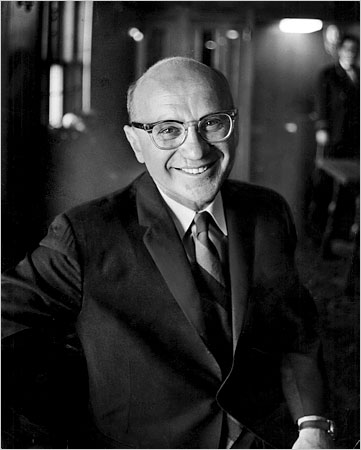
If there ever was a pithy answer you could give to all those who advocate communism & reservations to counter the apparent discrimination in a free & capitalist economy, Milton Friedman’s above statement would have to be the one!

In the family tree of advocates for a Laissez Faire capitalist economy during the 20th century, Milton Friedman was amongst the most prominent. An heir to the theories of economists like Adam Smith and Ludwig von Mises, Professor Freidman was awarded the Nobel Prize in Economics in 1976, for his achievement in the field of consumption analysis.

From being an advocate of John Maynard Keynes’ theory of a mixed economy during the WW-II years, Professor Friedman changed his views favoring the free market economy in the post war years.

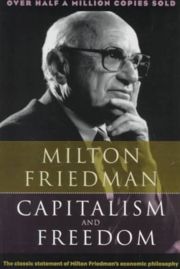
His book “Capitalism and Freedom” originally published in 1962 is recognized as amongst 50 best books of the 20th Century and has had profound influence on the economic policies of nations around the world.

As early as 1955, Professor Friedman in a memorandum to the Indian government, wrote

“The great untapped resource of technical and scientific knowledge available to India for the taking is the economic equivalent of the untapped continent available to the US 150 years ago”


Professor Milton Friedman passed away on November 16th, 2006.

Reference:
  1. www.wikipedia.com
  2. http://indiatodayonline.blogspot.com/2006/11/milton-friedman-on-india.html

Tuesday, November 21, 2006

The advertisement is selling you!


Selling a product, a service, an idea can be rather complicated. One must actually know what is being sold, what its applications are and who would find these products, services, ideas and their applications interesting.

Selling “those who find these applications interesting” to the seller, so that he can sell his products, his services, his ideas, to them can be even more complicated. The latter is what I have been trying to do for the past ten months.

You might by now be wondering what this profession is where I am apparently involved in selling people to another seller. Before you get all confused, angry and repulsed about the profession I am in and decide not to ever read anything written by such a disgusting person, I will tell you what this profession is. Its Advertising!

“Advertising is any paid form of non-personal presentation and promotion of ideas, goods, or services by an identified sponsor” – Definitions Committee of the American Marketing Association


Now, here is the question. Through advertising is a person or an entity actually selling products, services & ideas; or are they selling people to these products, services & ideas?

I think it is the latter.

If you are a marketing grad you would surely have had your professors and others tell you that “Advertising is a mass medium tool aimed at disseminating brand information”; or if you are an average Joe with a cable TV connection, you would have probably seen the show ‘Storyboard’ on CNBC-TV18, where guys with French beards, orange streaked hair and ear rings tell you stuff about target audience, product planning, branding, channels of distribution etc in relation to advertising.

At first instance, both the marketing grads and the average Joes amongst you might point out (to me) that, what the definitions committee, your professors and the French beard guys are telling, contradicts the “selling people to the product” idea.

But, voluntarily or involuntarily, what they are actually telling you is that Advertising is more of selling people to a product, service or idea, rather than the other way round!

Am I just stupid to continue asserting this, or is there some slinky, cunning meaning to this?

Well, you guessed right. Logical fallacy or not, consider the following reasoning.

You are a toothpaste company trying to sell your brand, through advertising. Once you have identified that your toothpaste is orange in color, you next go about identifying all those who find this an invigorating color for toothpaste. You then release an advertisement extolling the benefits of orange toothpaste in whitening ones teeth.

This process can also be understood as follows. Finding out the interested audience; application of this audience and the toothpaste’s interest in it, in context to the advertisement, is its purchasing power; and your goal for the advertisement is to “make a sale” of this audience’s purchasing power!

In effect, what actually is getting sold through an advertisement is the interested audience’s purchasing power for the product, service or an idea. Hence, there is a focus on target audience, product planning, branding, channels of distribution etc from the French beard guys and the focus on the masses that are being sold through the medium of advertising in your professors’ definition!

Make sense? Or, do you think I am saying this from an advertisement salesman’s (or more aptly, response executive, as we are known in my organization) perspective? To make your job easier in making sense of this, I will leave you with this further thought to chew upon. If my job it is to sell an advertisement to a toothpaste company wanting to sell their toothpaste, what will I be trying to “make a sale of” through the ad?

The toothpaste, the toothpaste company, the ad itself or ------------------------------------------------ your purchasing power for the toothpaste!


Friday, June 23, 2006

Three Cheers to Angelina!


This post is inspired by the recent CNN exclusive that I saw, titled “Angelina Jolie: On Her Mission and Motherhood”. I am not really a great fan of the charity and philanthropy brigade, who go about claiming to be pseudo saviors of the down-trodden and the backward, but something about the profile of this sultry screen icon as a United Nations Goodwill Ambassador seemed genuine. I have previously taken a stance that, charity and philanthropy should be consequence of individual’s judgment and not something as dictated by the society, and this was exactly the impression I got when I saw and heard about Angelina’s mission.

What is it that drives this sinfully beautiful Hollywood celebrity to take such an active interest in the lives of the refugees in Africa or Afghanistan or Cambodia? Surely it cannot be for publicity, she cannot have enough of it as a result of her celebrity life. Is she competing in a beauty pageant where she is being judged on her “Charitable Quotient”? I am confident that all men and most women would not disagree with me when I say that Angelina Jolie, would win any beauty pageant hands down, irrespective of her having a “Charitable Quotient” or not!


Whether it is adopting children who have been orphaned because of AIDS affected parents or supporting the cause of Afghan refugees during the height of post 9/11 Anti-Afghanistan frenzy, Angelina Jolie has stood her ground against the barrage of criticism. Criticism, for the fact that her philanthropy was based not on what society deemed fit, but based on her judgment.


I will conclude this post with a linguistic alliteration. As I saw the television documentary on Angelina, and saw the pictures of her amongst the malnourished and petrified natives of a suffering African nation I could not help but wonder if they thought of her as someone who had descended from the heavens, their own ‘pretty little angel’ which when translated into French would be ‘Angelina Jolie’ !

Read More here at Wikipedia

Note:

On a humorous note, to point out the fact that everyone has their own interest when it comes to charity, as I write this post I am also watching an episode of Sienfeld where Jerry is about to be audited by the IRS for claiming illegal tax deductions for contributing for a fraudulent volcano relief fund for Krakatoa. It becomes really hilarious when Jerry claims he did so “thinking only of the brave Krakatoans, who have suffered so much for so long!”

Thursday, June 01, 2006

“We want the industry to do it voluntarily!”


A book called Atlas Shrugged was published in 1957. I read it in 2001. There were two kinds of people in the book, the people who were pure evil and those who were unparalleled in their goodness. I thought, when I read it that this was a very unrealistic view of the world. In the book, the evil people scheme unrelentingly with a façade of doing a great help to the society and the good people initially bear these obnoxious atrocities without batting an eyelid. I thought, when I read the book that the ways of the world was not so "black and white", and that there have to be many shades of gray in between.

Over the past five years, one by one these shades of gray have started disappearing. But still, come on! There are still shades of gray, right? I mean that book was too much! Take for instance this court scene in this book. There is this brilliant industrialist who is single handedly capable of keeping the economy afloat and he is being prosecuted for something as stupid as selling his product to another company when there is some government regulation which prohibits this. Here is a small excerpt from this court scene “drama”

… He noted the stillness in the room. By the rules of complicated pretense which all those people played for one another’ benefit, they should have considered his stand as incomprehensible folly; there should have been rustles of astonishment and derision; there were none, they sat still; they understood.

“Do you mean that you are refusing to obey the law?” asked the judge.

“No. I am complying with the law – to the letter. Your law holds that my life, my work and my property may be disposed of without my consent. Very well, you may now dispose of me without my participation in the matter. I will not play the part of defending myself where no defense is possible, and I will not simulate the illusion of dealing with a tribunal of justice.”

“But, Mr. Rearden, the law provides specifically that you are to be given an opportunity to present your side of the case and to defend yourself”

“A prisoner bought to trial can defend himself only if there is an objective principle of justice recognized by his judges, a principle upholding his rights, which they may not violate and which he can invoke. The law, by which you are trying me, holds that there are no principles, that I have no rights and that you may do with me whatever you please. Very well. Do it.”

“Mr. Rearden, the law which you are denouncing is based on the highest principle – the principle of the public good.”

“Who is the public? What does it hold as good? There was a time when men believed that ‘the good’ was a concept to be defined by a code of moral values that no man had the right to seek his good through the violation of the rights of another. If it is now believed that my fellow men may sacrifice me in any manner they please for the sake of whatever they deem to be their own good, if they believe that they may seize my property simply because they need it – well, so does the burglar. There is only this difference: the burglar does not ask me to sanction his act.”…

{A few paragraphs and dialogues later}

“But we are giving you a chance to defend yourself – and it is you who are rejecting it.”

“I will not help you to pretend that I have a chance. I will not help you preserve an appearance of righteousness where rights are not recognized. I will not help you preserve an appearance of rationality by entering a debate in which a gun is the final argument. I will not help you to pretend that you are administering justice.”

“But the law compels you to volunteer a defense!”

There was laughter at the back of the courtroom.

That is the flaw in your theory, gentlemen.” Said Rearden gravely, “and I will not help you out of it. If you choose to deal with men by means of compulsion, do so. But you will discover that you need the voluntary co-operation of your victims, in many more ways than you can see at present. And your victims should discover that it is their own volition – which you cannot force – that makes you possible. I choose to be consistent and I will obey you in the manner you demand. Whatever you wish me to do; I will do it at the point of the gun. If you sentence me to jail, you will have to send armed men to carry me there – I will not volunteer to move. If you fine me, you will have to seize my property to collect the fine – I will not volunteer to pay it. If you believe that you have the right to force me – use your guns openly. I will not help you to disguise the nature of your action.”


Although this may seem out of context when read here, what the excerpt conveys is a logical fallacy. The judges are unable to pretend about the righteousness of their "laws" when the victim refuses to recognize the crime. If the victim refuses to voluntarily accept his “guilt” the tribunal is unable to interpret its own laws. I thought, when I read the book, that this was very unrealistic. I mean, what’s with all the volunteering? Surely, nobody would want another to voluntarily accept a noose around his own neck?

Today I saw an interview of Ms. Meira Kumar, Honorable Minister for Social Justice and Empowerment, conducted by Karan Thapar on CNBC TV18 on the topic of Reservations in the private sector. I would like to provide another excerpt, but as I do not have it verbatim, I will try to provide the gist. (*)

The topic revolved around the subject of whether the industry should be forced into accepting the reservations for SC/STs. After many instances of when the honorable minister shouted her way away from answering many of Mr. Thapar’s questions directly, there came her way a question.

Karan Thapar: “Minister, if the captains of industry (whom you have asked to come back with details of how many SCs and STs they have on their rolls) come back and tell you, that they do so in sufficient numbers what would you do then?”

Meira Kumar: “That’s too hypothetical a situation”

Karan Thapar: “But you want to base your decision to impose reservations on hypothetical data, which even your government data shows to be wrong, but here you do not want to answer a hypothetical question.”

Meira Kumar: “No, I will have to apply myself to this”

Karan Thapar: “Would you be verifying their data?”

Meira Kumar: “No, you are making it out that as though I am suspecting the captians of industry. I mean I will have to apply myself to this. I will have to look at what course of action I can take.”

Karan Thapar: “What would be your response to this after you have applied yourself to this. Would you then impose this reservation? What would be the course of action you take?”

Meira Kumar: “I don’t have to disclose every action I intend to take on television. It was I who told them [the industry] to check that they may already have SCs and STs on their rolls. Don’t be averse to having SC/STs on your rolls.”

Karan Thapar: “Yes, and if the industry has sufficient numbers already, then?”

Meira Kumar: “No, I will have to apply myself to this. I cannot say what my course of action would be. We don’t want it to be forced; we want the industry to create reservations in their rolls voluntarily.”


That’s when I realized that one more shade of gray had forever disappeared. This debate was very similar to the prosecution of Mr. Rearden in that book. This was not only about imposing reservations to some backward caste, tribe, class, sect etc in private sector. This was also about wanting the industry to voluntarily do it. Voluntarily hire people based not on the merit of being able to do the job, but being born in a backward segment of society. Voluntarily put a spanner in a running machine and pretend it is in the effort to administer justice. Voluntarily put a noose around one’s own neck and pretend it is the highest principle - the principle for the public good.

I realized that amongst my gray shades of doubt, one hue had become black. It proved the existence of a kind of rot in society which wanted others to volunteer guilt where none existed. It has also made me realize that I must look for those who when faced with such a request would react as Mr. Rearden reacted in the book at the end of that trial, by saying,

“… If it is now the belief of my fellow men, who call themselves the public, that their mood requires victims, then I say: The public good be damned, I will have no part of it!”

Notes

(*) Please note that the dialogue posted here between Ms. Meira Kumar and Mr. Karan Thapar is not the exact transcript and has been written in my words, about what I heard transpired in that interview. If anybody can provide me with the actual transcripts I would immediately replace the same here.

References


1. Atlas Shrugged by Ayn Rand, Signet Books, 1957

Monday, May 29, 2006

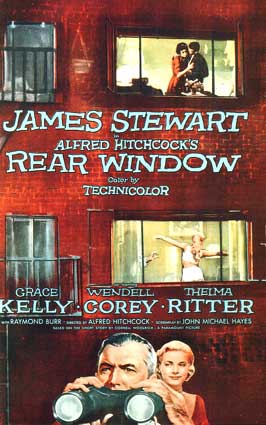
Rear Window


Any search on the internet for the best crime/mystery movies will always link somehow to Alfred Hitchcock. And among his many movies two stand out: “Psycho” and “Rear Window.” Both these movies are cult classics mainly because of their superb story telling in archetypal Hitchcock-ian style. After seeing the History Channel’s montage on Hollywood villains, and after being bitten by the bug, I decided to rent a Hitchcock movie, on a recent rainy Sunday afternoon.

Rear Window, based on Cornell Woolrich’s short story was released after Psycho with a punch-line which read “See it! If your nerves can stand it after PSYCHO.” A classic crime noir fiction, Rear Window is a story about how an invalidated shutter bug with a nothing much else to do as his leg is in a cast, sets about trying to solve a neighborhood murder.

What sets it apart from the macabre Psycho is the humorous undercurrent in the entire movie. The lead character, L.B. Jefferies played by James Stewart is uncomfortable about his plight, but is nevertheless indifferent about it. He is going through his six weeks stuck to his wheel chair and his situation is an apt example for the proverb “An idle mind is a devil’s workshop”. Not only does he spend his time looking through the window and into the lives of his neighbors, he also starts doubting if his fiancée is the right woman for him!

Rear Window is also a romance in its own right. The fiancée played by Grace Kelly is a popular socialite. She, according to James Stewart’s character, who as a news photographer travels to the distant and unknown parts of the world, is too high society for his comfort. Part of the movie is how Grace Kelly’s character proves to him that she is just as adventurous as he is.

Written by Cornell Woolrich, who has been termed as the father of noir fiction, and directed by the great Alfred Hitchcock, Rear Window is a great picture for crime movie buffs.

Saturday, March 11, 2006

Market Research and the Media

{Also cross-posted at the Indian Media Bash Blog. Read Here }


Having recently joined the media advertising industry, I now have to deal with an overwhelming amount of data pertaining to various market data. In the print industry certain figures hold a lot of value; they are the Audit Bureau of Circulation figures called the ABCs and the National Readership Survey figures called the NRS-es. These data provide an estimate of the number and habits of people reading newspapers and magazines. This is very relevant for marketing the newspaper or magazine to the advertisers because most decisions about media buying are based on these figures. It helps the advertiser ascertain the kind of readers who will eventually see their advertisements and if it will provide them with expected response.

Targeting the Decision Maker

With the demographics of India showing a considerable skew towards a youthful populace and as youngsters with larger disposable incomes become independent decision makers, more and more advertisers are now very interested in knowing the habits of these decision makers. While the ABCs and the NRS-es give the data about the reach the media instruments have, the DMS or the Decision Makers Survey, now presents a very important value proposition to the advertiser. What this mainly describes is the kind of readership the publication has among decision makers, whether it be in terms of corporate decisions or day to day household purchase decisions. For instance FMCG companies selling a product like Sunflower Oil would rather advertise in a family channel like Star Plus which is watched by a large number of household purchase decision makers, the housewives rather than CNBC which is watched more by business men.

Experiential Media

What is also relevant in the media today is a shift towards more experiential platforms of advertising. Advertisers today are looking at providing the customer with an experience with their brands and not just the product. This is based on the psychographics, or attitudes and behaviors of the consumer. It has been ascertained, for instance that due to the rising attention deficiency syndrome amongst readers of a newspaper the time spent by an average reader with a newspaper is significantly lower than before. What this means is that, the print advertisements although reaching the audience indicated by the readership figures of the NRS-es and ABCs, are not actually providing brand connect. Hence it becomes imperative for the advertiser to look for media which does not only provide an Opportunity to See, but actually an Opportunity to Experience.

So its market research then?

So it is clear that market research and surveys is an integral cog in the wheels of the media decision vehicle. But can all decisions be taken based on these surveys? Although generally when one is presented with such a question, we usually disagree and say that not all marketing decisions can be taken based on market research; there are very few arguments which disapprove of it as a useful tool. But, I was recently introduced to a rather potent argument about how market research is not all powerful as claimed by the statisticians and hardcore data junkies. Consider a scenario where a toothpaste company conducting a market survey about its product, poses various questions to its users about the taste, smell, color, package ergonomics etc. The kind of response which can be expected could be about wanting a higher mint flavor, a fresher smell, a greener color and so on. But what the argument contends is that by conducting such a conventional market survey, what the toothpaste company is getting are only incremental improvement suggestions for their product and not very significant experiential changes. For instance, because of a restrictive question set in the market survey pertaining to the past and current experiences of consumers about the product, the company loses out in tapping aspirations of the consumer for newer experiences like that of a teeth protecting chewing gum.

Capturing Relevant Audiences

This above situation is a very relevant discrepancy in terms of a market research exercise because of its reliance on past and current experiences as the basis on which the future is to be extrapolated. While these suggestions are predominantly incremental improvements in nature, what is more relevant today is capturing the experiential aspirations for the future. Also important is the need to make the advertising reach the relevant audience more than anybody, and with values becoming more and more embedded in experiences than in just the product, market research has to be redefined from being survey figures to being portals to experiential aspirations of relevant audiences.

Custom Search